Materials
How to print ABS and ASA: enclosure, temperatures and warping
ABS and ASA are the step after PETG when a part has to withstand real heat: a car dashboard in summer, a housing next to a motor, a bracket in the sun. They print almost the same way and share the same enemy: they shrink as they cool and lift their corners. Here's what sets them apart, which temperatures to start from and what to do so the part comes out flat, based on what Prusa and Bambu Lab recommend.
ABS and ASA: close cousins
Both are styrene-family plastics: hard, tough and heat-resistant. Bambu Lab describes ABS as an affordable, durable material for tough parts and ASA as “a common alternative to ABS” with better UV, temperature and impact resistance. Prusa sums it up: ASA handles sunlight better, warps less and smells less than ABS, and withstands up to about 93 °C.
The rule of thumb: ASA for anything that lives outdoors and ABS for indoor parts that need to handle heat, especially if you want to smooth them with acetone. If your part never goes above 60 °C, PETG will probably do, and it's much easier to print; we compare them in PLA, PETG or ABS and, for outdoor use, in PLA, PETG or ASA outdoors.
Starting temperatures
Every filament maker gives its range on the data sheet. For reference, this is what two of them recommend for their own materials:
| Material and source | Nozzle | Bed | Fan |
|---|---|---|---|
| ABS · Prusa | 255 °C | 100 °C (80-110 by size) | — |
| ASA · Prusa | 260 °C | 105 °C first layer, 110 °C after | — |
| ABS and ASA · Bambu Lab | 240-280 °C | 90-100 °C (smooth or textured PEI) | 0-80% |
Bambu Lab adds a speed limit of under 300 mm/s. Both brands agree on what matters: a nozzle well above PETG temperatures and a bed above 90 °C. That rules out quite a few printers and, as you'll see, the nozzle isn't the only thing that counts.
Why the corners lift
According to Prusa, an ABS part shrinks by around 1-2% as it cools. It doesn't sound like much, but it doesn't all shrink at once: the freshly laid upper layers cool surrounded by air, while the lower ones stay warm on the bed. As the upper layers contract they pull inwards and the part curls like a bimetallic strip: the corners come off the bed. On tall parts, a cold draft can also open a crack between two layers.
That's why every fix points the same way: let the part cool slowly and evenly, and keep the first layer firmly stuck in the meantime.
The enclosure: close to mandatory
Prusa is clear: for ABS, the printer should be inside an enclosure that keeps the surrounding air warm. Bambu Lab puts it first in its tips for both materials: an enclosed chamber keeps the temperature around the print consistent, reduces warping and improves quality. For small parts on an open printer, Prusa suggests PrusaSlicer's draft shield (under “Skirt and brim”), a thin wall printed around the part that shields it from drafts.
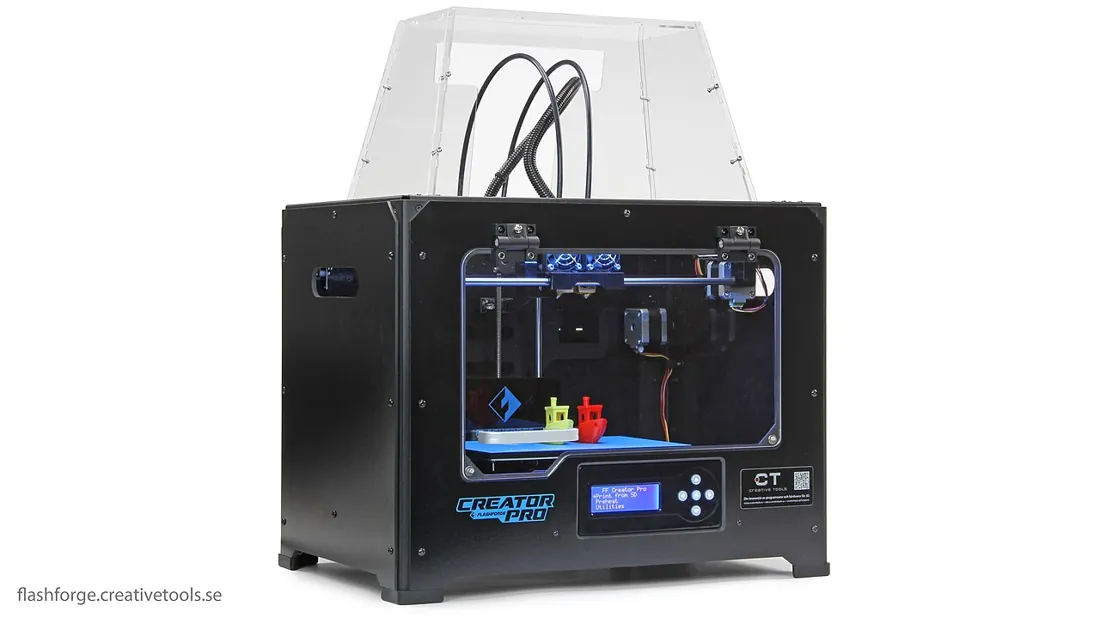
One warning from Prusa about ASA: printing a lot of it in an enclosure without ventilation can end up deforming the fan shroud or the extruder's plastic parts. If your printer has PLA or PETG printed parts on the toolhead, keep an eye on them.
How many printers can handle these materials? We counted them in our catalogue, crossing each machine's verified maximum nozzle temperature with whether it's enclosed or open:
How many reach ABS's temperature?
- Enclosed
- Open
- ABS needs at least 240 °C
The full list, machine by machine, is in the ABS compatibility checker (and in the ASA one). If you're buying with these materials in mind, start with the enclosed 3D printers.
The bed and the first layer
Prusa recommends printing both on a smooth or powder-coated PEI sheet with a glue stick, and warns that acetone or ABS slurries must not be used on powder-coated sheets. Bambu Lab accepts smooth or textured PEI at 90-100 °C and recommends a brim: more surface stuck to the bed means more grip to resist the corners pulling up.
The rest is the usual: a clean, grease-free bed and a well-squished, slower first layer. The causes and fixes are in why prints don't stick.
Fan and drafts
With PLA the part fan runs flat out; with ABS and ASA, the opposite. Bambu Lab gives a 0-80% range for the part cooling fan, and Prusa specifically asks for no drafts around the part. In practice: fan low or off for the first layers, the enclosure door closed, and the printer away from windows and air conditioning.
Dry it, even if it doesn't look wet
Bambu Lab considers drying ABS and ASA optional but “strongly recommended” to avoid poorly bonded layers and brittle parts, and gives 80 °C for 8 hours in a convection oven. Prusa notes that ASA is partially hygroscopic. Methods and a table by material are in how to dry filament.
The fumes: ventilate the room
Both brands list it among the downsides. Prusa talks about fumes with potentially dangerous substances such as styrene and asks for a well-ventilated room (without drafts over the part). Bambu Lab, more bluntly, calls them “pungent fumes”. Don't print ABS in the bedroom or wherever you spend many hours; what studies say about emissions is summarised in is 3D printing at home safe?.
Finishing: acetone and annealing
ABS's big advantage over almost everything else: Prusa explains that it can be smoothed with acetone vapour for a smooth, glossy finish, and that ASA also accepts acetone smoothing and gluing. Acetone dissolves the surface and erases the layer lines, but it also rounds off edges and fine details. It's highly flammable: never heat it, work away from any flame or spark and keep the room ventilated.
Bambu Lab also lists annealing at 80-90 °C for 6-12 hours for these two materials: heating the finished part below its softening point to relax internal stresses. It can change the dimensions slightly, so try it first on a part that isn't critical. If you're gluing several parts together, how to glue 3D printed parts covers adhesives by material.
Summary: the ABS and ASA checklist
- Nozzle at 240-280 °C per the data sheet; bed at 90-110 °C.
- An enclosed printer (or, for small parts, a draft shield) and no drafts.
- Smooth or powder-coated PEI with glue, and a brim on large parts.
- Part fan low or off.
- Dry filament and a ventilated room.
Frequently asked questions
- Can you print ABS without an enclosure?
- Small parts, sometimes. Prusa recommends keeping the printer inside an enclosure so the surrounding air stays warm; as an alternative for small parts it suggests PrusaSlicer's “draft shield”, a wall printed around the part that protects it from drafts. For large parts, an enclosure is close to mandatory.
- Which is better, ABS or ASA?
- For outdoor use, ASA: according to Prusa it resists UV far better, warps less and smells less than ABS. ABS is usually cheaper and easier to find in many colours. Both print in a very similar way.
- What temperature do you print ABS at?
- Prusa recommends a 255 °C nozzle and a 100 °C bed (80-110 °C depending on the part's size). Bambu Lab gives a 240-280 °C nozzle range and a 90-100 °C bed for its ABS. Use your filament's data sheet as the starting point.
- Is printing ABS at home dangerous?
- Prusa warns that ABS and ASA release fumes containing substances such as styrene and asks you to print them in a well-ventilated room, without creating drafts over the part. What is known about printer emissions is summarised in our article on safety.
Sources
- Prusa Knowledge Base — ABS
- Prusa Knowledge Base — ASA
- Bambu Lab — Ultimate Guide to ABS 3D Printing Filament
- Bambu Lab — Ultimate Guide to ASA 3D Printing Filament
- Printer temperatures and enclosures: verified data from the hotend catalogue.
- Photo from Wikimedia Commons, with author and licence in the caption.