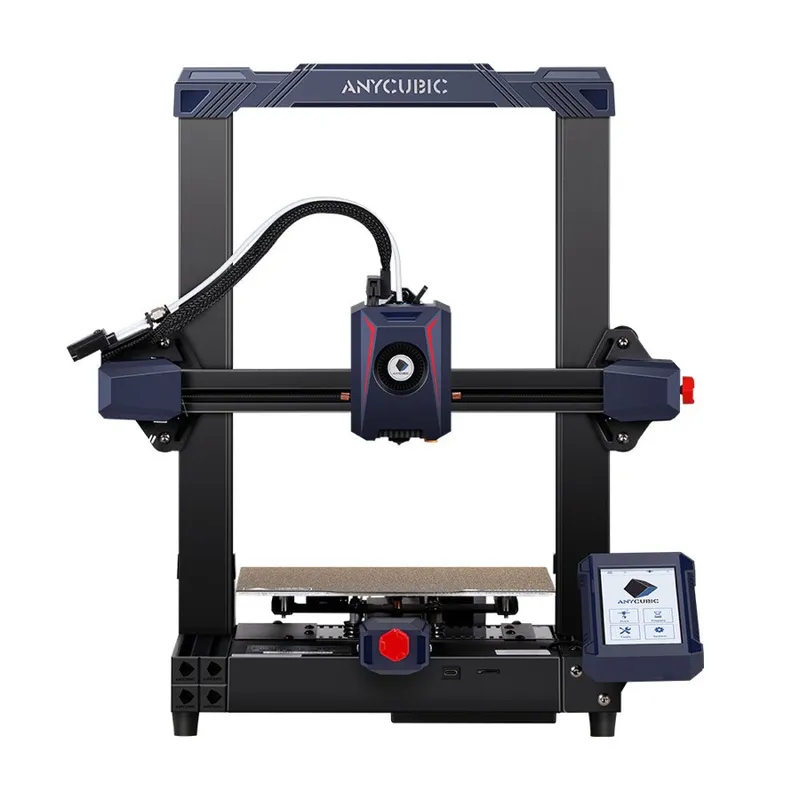
Product image from the manufacturer or its official distributor, reproduced to identify the model.
Kobra 2
The Anycubic Kobra 2 is a FDM 3D printer released in 2023 by Anycubic, with a build volume of 250×220×220 mm and MSRP of €279. Claimed maximum speed: 300 mm/s.
Manufacturer's suggested retail price (MSRP). Not the store price — the actual price may vary.
Our take on the Kobra 2
The Kobra 2 is the base model of the second Kobra generation: 250 × 220 × 220 mm, a direct extruder, a brass nozzle up to 260 °C, a 110 °C bed and LeviQ 2.0 automatic levelling. Anycubic claims 300 mm/s, less than the 500 of its sibling, the Kobra 2 Pro.
It's one of the cheapest filament printers in the catalogue and does the job for starting out with PLA, PETG or TPU. But within Anycubic it has already been overtaken by the Kobra 3 and the Kobra 4, with a 300 °C nozzle and ready for ACE Pro multicolour; outside it, the Creality Ender 3 V3 SE is its price rival.
Worth knowing: its claimed acceleration (5,000 mm/s²) is low next to the 20,000 mm/s² of many recent machines, it has no camera or multicolour, and the brass nozzle isn't meant for fibre-filled filaments. It's open-frame, so ABS comes with caveats. If it's your first printer, start with common first 3D printer mistakes.
Written from its specs and the sources cited at the end of this page; we haven't tested it in person.
Technical specifications
| Technology | FDM |
|---|---|
| Build volume | 250×220×220 mm |
| Weight | 8.4 kg |
| Max speed | 300 mm/s |
| Max acceleration | 5,000 mm/s² |
| Max nozzle temp | 260 °C |
| Nozzle material | brass |
| Drive | direct |
| Flow rate | — |
| Max bed temp | 110 °C |
| Bed material | PEI plate |
| Auto-leveling | LeviQ 2.0 auto mesh |
| Enclosed | No |
| Heated chamber | No |
| AMS compatible | No |
| WiFi | Yes |
| Camera included | No |
| Official slicer | Anycubic Slicer Next |
| OrcaSlicer support | Yes |
| Power | 350 W |
| Noise | — |
What materials can the Kobra 2 print?
This comes from four facts on its spec sheet: the nozzle reaches 260 °C, the bed 110 °C, and the machine is open-frame with a direct-drive extruder. Those four facts decide most of the list: nozzle temperature sets the ceiling on what you can melt, the bed decides whether the first layer sticks, the enclosure keeps large parts from warping, and the extruder type rules flexibles. We don't test the machine — this is guidance derived from verified data, not a guarantee.
In short: it prints PLA, PETG, TPU (flexible) without a fight, and it can reach ABS, ASA, Nylon (PA), PLA-CF, PETG-CF, PA-CF (Nylon CF) with conditions — the detail for each is below.
| Material | Prints it? | Why |
|---|---|---|
| PLA | Yes | Yes. PLA has no special needs: any FDM printer like the Kobra 2 prints it out of the box. |
| PETG | Yes | Yes. With a nozzle up to 260 °C and a bed up to 110 °C it comfortably meets PETG's needs. |
| TPU (flexible) | Yes | Yes. It has a direct-drive extruder, ideal for flexibles; prints TPU well (go slow). |
| ABS | With caveats | With caveats. It reaches 260 °C, but it's open-frame: ABS can warp and ventilation is advised. Doable in a draft-free spot or by adding an enclosure. |
| ASA | With caveats | With caveats. It reaches 260 °C, but it's open-frame: ASA can warp and ventilation is advised. Doable in a draft-free spot or by adding an enclosure. |
| Nylon (PA) | With caveats | With caveats. It reaches 260 °C but is open-frame; Nylon warps in drafts and absorbs moisture. Enclosure + drying almost mandatory. For carbon-fibre variants, use a hardened-steel nozzle. |
| Policarbonato (PC) | Not recommended | Not recommended. With 260 °C nozzle and/or no enclosure, PC won't print reliably. |
| PLA-CF | With caveats | With caveats. Its stock nozzle is brass and PLA-CF's fibre wears it down: swap it for a hardened one before printing it regularly. |
| PETG-CF | With caveats | With caveats. Its stock nozzle is brass and PETG-CF's fibre wears it down: swap it for a hardened one before printing it regularly. |
| PA-CF (Nylon CF) | With caveats | With caveats. Its stock nozzle is brass and PA-CF (Nylon CF)'s fibre wears it down: swap it for a hardened one before printing it regularly. |
Need the materials it struggles with? These printers handle them
ABS, ASA, Nylon (PA), Policarbonato (PC), PLA-CF, PETG-CF, PA-CF (Nylon CF)
Popular comparisons
Own the Kobra 2? Write a review
User opinions, moderated before publishing. hotend doesn't verify purchases.
Sources & references
Specs cross-checked against these public sources:
- Web oficial fabricanteManufacturer page
Specs taken from the sources cited above; we have no recorded date for the last check. Confidence in the data: medium.