Materials
Specialty filaments: silk, matte, wood, metal, glow-in-the-dark and carbon fibre
Almost every “specialty” filament is PLA or PETG with something added: an additive for shine, wood or metal particles, a pigment that glows in the dark or short carbon fibres. That addition changes the part's look or properties, but also how it has to be printed, and in some cases it eats the nozzle. Here's what each one contains and what it needs, based on what Prusa and Bambu Lab say.
Two groups: looks only, and particle-filled
The split that matters isn't the brand name but what's inside:
- Finish only (silk, matte): they print like regular PLA, with a few tweaks to look their best.
- Particles or fibres (wood, metal, glow-in-the-dark, carbon or glass fibre): particles can clog a narrow nozzle and, if they're hard, wear brass. For these, the nozzle matters.
| Filament | What's in it | Nozzle | Watch out for |
|---|---|---|---|
| Silk | Pearlescent additives | Any | Uneven shine if speed changes |
| Matte | Non-glossy finish | Any | Little to watch |
| Wood | Wood particles | 0.6 mm or larger (per Prusa) | Clogs; more brittle parts |
| Metal-filled | Metal powder | Hardened steel | Wear and clogs |
| Glow-in-the-dark | Strontium aluminate | Hardened steel | Very abrasive |
| Carbon or glass fibre | Short fibres | Hardened steel | Brittle on impact; clogs |
Silk PLA: the shine depends on how you print it
Bambu Lab explains that its PLA Silk is standard PLA with pearlescent additives that give it a silky or metallic sheen, meant for decorative parts. The interesting part is that the shine isn't down to the filament alone: according to its guide, it depends mainly on three things.
- Outer wall speed. Slower gives more gloss, because the material has time to level out; too fast leaves a microscopically rough surface that scatters light. It recommends 40-60 mm/s (start with 50).
- Keeping that speed constant. If the outer wall speeds up in some areas and slows in others, the same part comes out bright in some places and dull in others. That's why it suggests enabling the option that stops the slicer slowing down outer walls.
- A slightly higher temperature. Between 210 and 240 °C; Bambu Lab recommends 235 °C for its filament.
It adds two orientation and quality tips: print with the most visible face upright (laid flat, layer lines show more) and drop the layer height to 0.16 mm on curved parts. And dry it first: silk absorbs moisture relatively easily, and when damp it strings and shines unevenly. More on drying in how to dry filament.
Matte PLA: hides the layers
Matte is the opposite of silk. Bambu Lab says its PLA Matte significantly reduces visible layer lines with a smooth, non-glossy finish, for architectural models, design pieces or display parts, and that it's compatible with all its printers, plates and nozzles. It prints like any PLA. It's a good choice for parts that will be seen up close that you don't want to sand or paint (if you do, see how to sand and paint PLA parts).
Wood and metal: they imitate the material, not its properties
Prusa groups filaments with wood or metal particles (usually on a PLA or PETG base) and is clear about it: they're used mostly for looks, to imitate the material. In exchange they have worse mechanical resistance and layer adhesion, are more brittle, abrasive and clog-prone, and don't get along with multi-material systems.
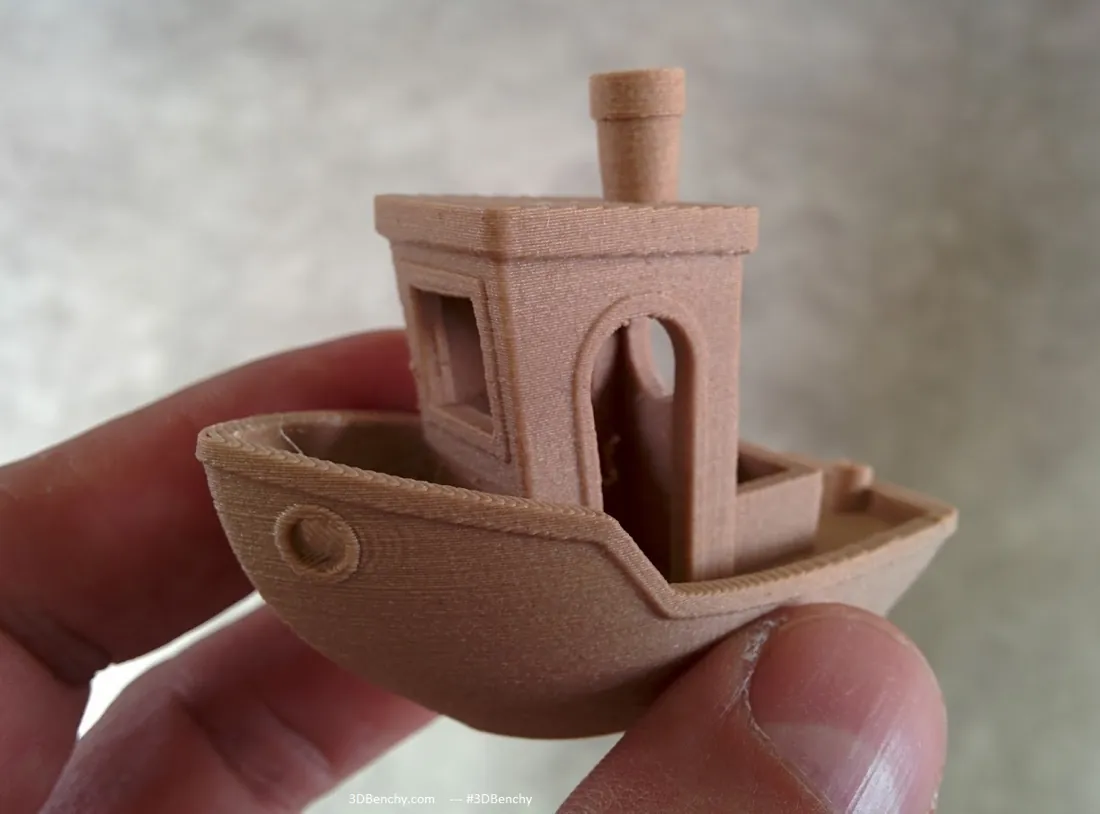
Its recommendations for printing them:
- Wood: a nozzle of at least 0.6 mm and 0.2 mm layers to avoid clogs. There are exceptions: Prusa says its own Prusament Woodfill prints easily with the standard 0.4 mm brass nozzle, at 195 °C. Parts can be stained for a weathered look.
- Metal: a hardened steel nozzle. Parts can be polished with 600-1500 grit (or finer) wet sandpaper and polishing paste, up to a metallic shine.
- Both: best adhesion is on smooth PEI. Temperatures vary a lot by base (Prusa gives a 190-270 °C nozzle and a 60-100 °C bed), so the filament's data sheet rules.
Marble- or stone-effect filaments usually carry coloured flecks or particles: if their data sheet says they're abrasive, treat them like these.
Glow-in-the-dark: the most abrasive of all
The usual pigment in these filaments is strontium aluminate, a very hard crystal. Prusa puts it bluntly in the guide for its PETG Ultraglow: it's “the most abrasive material we've ever made”, it requires a hardened nozzle, and it also speeds up wear on PTFE tubes and hardened parts such as gears and steel nozzles. It suggests a 0.6 mm nozzle to avoid clogs. The glow charges best under ultraviolet light and lasts several hours in the dark.
A few stars for the ceiling won't ruin the printer, but don't make it your everyday filament on a brass nozzle.
Carbon and glass fibre: stiffness at the cost of brittleness
Here the fibres do change the properties. Prusa explains that carbon, glass or kevlar fibres mixed into the plastic improve dimensional stability (less warping), make the part lighter and raise temperature and tensile resistance, but usually reduce impact resistance and layer adhesion. In other words: stiffer parts, not indestructible ones. The filament is more brittle, clogs more easily and requires a hardened steel nozzle.
Bambu Lab agrees for its PLA-CF: stiffer and stronger than regular PLA, but with low heat resistance, like PLA, and abrasive to the nozzle. It prints it at 210-240 °C with the fan at 50-100%, and recommends drying it at 55 °C for 8 hours. PETG, nylon or PC versions with fibre inherit their base plastic's demands: for nylon and PC, an enclosed printer (we explain why in how to print ABS and ASA, which share that problem).
Which nozzle does your printer have?
Before buying a spool of carbon fibre or glow-in-the-dark filament, check which nozzle your machine has. In our catalogue, this is the split:
Which nozzle the catalogue's FDM printers ship with
If yours is brass, many printers let you swap it for a hardened one. The difference between nozzle materials, and when it's worth swapping, is covered in what is a hotend. And to see which base materials each machine can print, there's the material compatibility checker.
Frequently asked questions
- Which filaments need a hardened steel nozzle?
- The ones with hard particles: carbon fibre, glass fibre, metal-filled and glow-in-the-dark. Prusa calls the strontium aluminate in its glow-in-the-dark PETG “the hardest material we ever used” and asks for a hardened nozzle. Silk and matte PLA don't need one.
- Does wood filament clog the nozzle?
- It can. For wood-filled filaments Prusa recommends a nozzle of at least 0.6 mm and 0.2 mm layers to avoid clogs, except for its Prusament Woodfill, which according to Prusa prints easily with the standard 0.4 mm brass nozzle.
- Are carbon fibre parts stronger?
- Stiffer and more stable, not necessarily stronger at everything. Prusa explains that the fibres improve dimensional stability, temperature resistance and tensile strength, but usually reduce impact resistance and layer adhesion.
- How do I get more shine from silk PLA?
- According to Bambu Lab: a slow, steady outer wall (40-60 mm/s, try 50), a slightly higher temperature (it recommends 235 °C), 0.16 mm layers and the most visible face printed upright. And dry filament.
Sources
- Bambu Lab Wiki — PLA Silk / Silk+ Filament Printing Guide
- Bambu Lab — PLA Matte
- Bambu Lab — Ultimate Guide to PLA-CF
- Prusa Knowledge Base — Composite materials (with metal or wood particles)
- Prusa Knowledge Base — Prusament Woodfill
- Prusa Knowledge Base — Composite materials filled with carbon, kevlar or glass
- Prusa Knowledge Base — Prusament PETG Ultraglow troubleshooting
- Printer nozzles: verified data from the hotend catalogue.
- Photo from Wikimedia Commons, with author and licence in the caption.