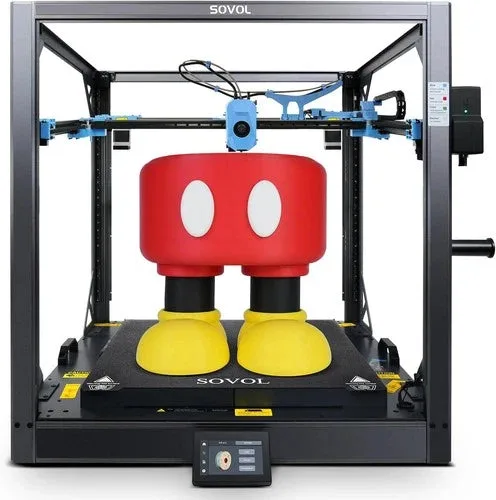
Product image from the manufacturer or its official distributor, reproduced to identify the model.
SV08 Max
The Sovol SV08 Max is a FDM 3D printer released in 2025 by Sovol, with a build volume of 500³ mm and MSRP of €1,199. Claimed maximum speed: 700 mm/s.
Manufacturer's suggested retail price (MSRP). Not the store price — the actual price may vary.
Our take on the SV08 Max
The SV08 Max is the giant version of the SV08: an open 500 × 500 × 500 mm CoreXY, with a claimed 700 mm/s and 40,000 mm/s², a 300 °C nozzle, a 100 °C bed, eddy-current scanning for levelling and a built-in camera. It's for large parts in one go: helmets, models, furniture or whole batches of parts.
By volume, only the Elegoo OrangeStorm Giga, at 800 × 800 × 1000 mm, beats it in the catalogue. Below it sit the Creality Ender-5 Max, at 400 mm per side, and the Elegoo Neptune 4 Max. Within Sovol, the SV08 is the same idea at 350 mm.
Worth knowing: it's open, so large ABS parts, exactly what it invites you to print, warp without an enclosure, and it has no multicolour. Parts this size take many hours, and a failure halfway through costs a lot of filament. If your part doesn't fit a normal printer, you can also cut it into pieces.
Written from its specs and the sources cited at the end of this page; we haven't tested it in person.
Technical specifications
| Technology | FDM |
|---|---|
| Build volume | 500³ mm |
| Weight | — |
| Max speed | 700 mm/s |
| Max acceleration | 40,000 mm/s² |
| Max nozzle temp | 300 °C |
| Nozzle material | — |
| Drive | direct |
| Flow rate | — |
| Max bed temp | 100 °C |
| Bed material | — |
| Auto-leveling | Eddy current scanning |
| Enclosed | No |
| Heated chamber | No |
| AMS compatible | No |
| WiFi | Yes |
| Camera included | Yes () |
| Official slicer | OrcaSlicer |
| OrcaSlicer support | — |
| Power | — |
| Noise | — |
What materials can the SV08 Max print?
This comes from four facts on its spec sheet: the nozzle reaches 300 °C, the bed 100 °C, and the machine is open-frame with a direct-drive extruder. Those four facts decide most of the list: nozzle temperature sets the ceiling on what you can melt, the bed decides whether the first layer sticks, the enclosure keeps large parts from warping, and the extruder type rules flexibles. We don't test the machine — this is guidance derived from verified data, not a guarantee.
In short: it prints PLA, PETG, TPU (flexible) without a fight, and it can reach ABS, ASA, Nylon (PA), Policarbonato (PC) with conditions — the detail for each is below.
| Material | Prints it? | Why |
|---|---|---|
| PLA | Yes | Yes. PLA has no special needs: any FDM printer like the SV08 Max prints it out of the box. |
| PETG | Yes | Yes. With a nozzle up to 300 °C and a bed up to 100 °C it comfortably meets PETG's needs. |
| TPU (flexible) | Yes | Yes. It has a direct-drive extruder, ideal for flexibles; prints TPU well (go slow). |
| ABS | With caveats | With caveats. It reaches 300 °C, but it's open-frame: ABS can warp and ventilation is advised. Doable in a draft-free spot or by adding an enclosure. |
| ASA | With caveats | With caveats. It reaches 300 °C, but it's open-frame: ASA can warp and ventilation is advised. Doable in a draft-free spot or by adding an enclosure. |
| Nylon (PA) | With caveats | With caveats. It reaches 300 °C but is open-frame; Nylon warps in drafts and absorbs moisture. Enclosure + drying almost mandatory. For carbon-fibre variants, use a hardened-steel nozzle. |
| Policarbonato (PC) | With caveats | With caveats. It has the temperature (300 °C) but is open-frame; PC warps badly without an enclosure. Only with one added. For carbon-fibre variants, use a hardened-steel nozzle. |
| PLA-CF | No data | Its nozzle isn't verified. PLA-CF needs a hardened one; brass wears down with the fibre. |
| PETG-CF | No data | Its nozzle isn't verified. PETG-CF needs a hardened one; brass wears down with the fibre. |
| PA-CF (Nylon CF) | No data | Its nozzle isn't verified. PA-CF (Nylon CF) needs a hardened one; brass wears down with the fibre. |
Need the materials it struggles with? These printers handle them
ABS, ASA, Nylon (PA), Policarbonato (PC)
Popular comparisons
Own the SV08 Max? Write a review
User opinions, moderated before publishing. hotend doesn't verify purchases.
Sources & references
Specs cross-checked against these public sources:
- Sovol EU official product pagemanufacturer
- Sovol US official product pagemanufacturer
- West3D retailer listingretailer
- Amazon US listingretailer
- Tom's Hardware reviewreview
Specs checked against the sources cited above on 19/06/2026. Confidence in the data: high.