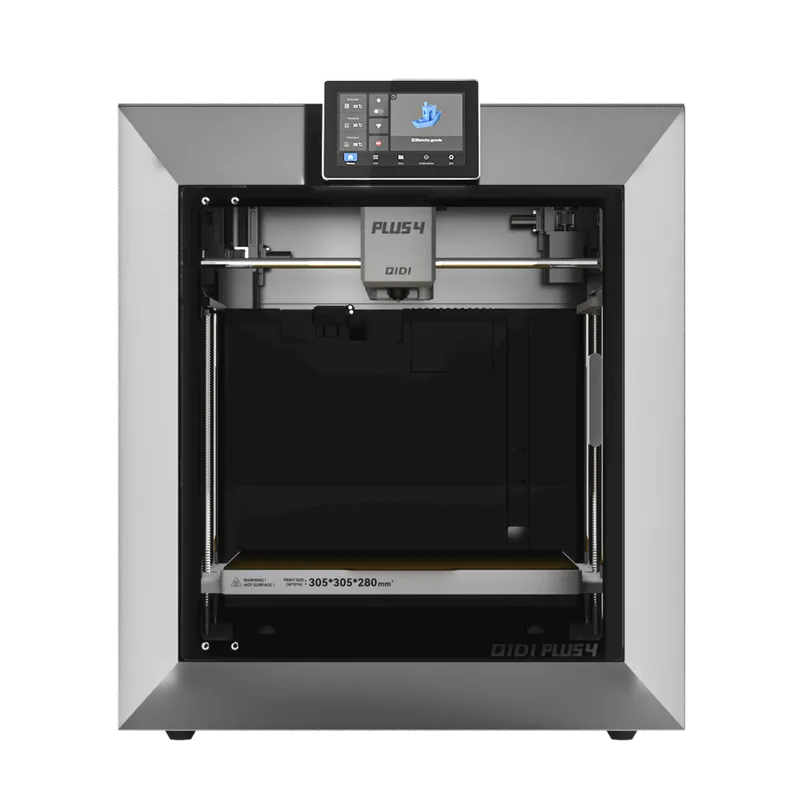
Product image from the manufacturer or its official distributor, reproduced to identify the model.
Plus4
The QIDI Tech Plus4 is a FDM 3D printer released in 2024 by QIDI Tech, with a build volume of 305×305×280 mm and MSRP of €799. Compatible with QIDI Box. Enclosed chamber. Active heated chamber. Claimed maximum speed: 600 mm/s.
Manufacturer's suggested retail price (MSRP). Not the store price — the actual price may vary.
Our take on the Plus4
The Plus4 is QIDI's current large enclosed printer: 305 × 305 × 280 mm, an actively heated chamber up to 65 °C, a quick-swap hardened-steel nozzle up to 370 °C, a 120 °C bed and QIDI Box support. Its claimed flow rate, 50 mm³/s, is among the highest in the catalogue, and it has a 1080p camera.
Against the previous-generation X-Plus 3, it gains volume, nozzle temperature and multicolour; the Max4 is the even larger option. Outside QIDI, the Creality K2 Pro and the Anycubic Kobra S1 Max also combine a heated chamber and multicolour.
Worth knowing: it takes up a cube about 54 cm on each side and its stated power is 1,000 W, a heat-up peak rather than continuous draw. For PLA and small parts it's more machine than you need, and single-nozzle multicolour purges filament at each change.
Written from its specs and the sources cited at the end of this page; we haven't tested it in person.
Technical specifications
| Technology | FDM |
|---|---|
| Build volume | 305×305×280 mm |
| Weight | 16 kg |
| Max speed | 600 mm/s |
| Max acceleration | 20,000 mm/s² |
| Max nozzle temp | 370 °C |
| Nozzle material | hardened steel |
| Drive | direct |
| Flow rate | 50 mm³/s |
| Max bed temp | 120 °C |
| Bed material | PEI plate |
| Auto-leveling | auto mesh + strain gauge |
| Enclosed | Yes |
| Heated chamber | Yes |
| AMS compatible | Yes (QIDI Box) |
| WiFi | Yes |
| Camera included | Yes (1080p) |
| Official slicer | Qidi Studio (OrcaSlicer fork) |
| OrcaSlicer support | Yes |
| Power | 1000 W |
| Noise | — |
What materials can the Plus4 print?
This comes from four facts on its spec sheet: the nozzle reaches 370 °C, the bed 120 °C, and the machine is enclosed with a direct-drive extruder. Those four facts decide most of the list: nozzle temperature sets the ceiling on what you can melt, the bed decides whether the first layer sticks, the enclosure keeps large parts from warping, and the extruder type rules flexibles. We don't test the machine — this is guidance derived from verified data, not a guarantee.
In short: it prints PLA, PETG, TPU (flexible), ABS, ASA, Nylon (PA), Policarbonato (PC), PLA-CF, PETG-CF, PA-CF (Nylon CF) without a fight.
| Material | Prints it? | Why |
|---|---|---|
| PLA | Yes | Yes. PLA has no special needs: any FDM printer like the Plus4 prints it out of the box. |
| PETG | Yes | Yes. With a nozzle up to 370 °C and a bed up to 120 °C it comfortably meets PETG's needs. |
| TPU (flexible) | Yes | Yes. It has a direct-drive extruder, ideal for flexibles; prints TPU well (go slow). |
| ABS | Yes | Yes. Nozzle up to 370 °C and an enclosure: it contains ABS's warping and fumes. |
| ASA | Yes | Yes. Nozzle up to 370 °C and an enclosure: it contains ASA's warping and fumes. |
| Nylon (PA) | Yes | Yes. It reaches 370 °C and is enclosed: it prints Nylon (dry it well first). For carbon-fibre variants, use a hardened-steel nozzle. |
| Policarbonato (PC) | Yes | Yes. Nozzle up to 370 °C and an enclosure with active heating: suitable for PC. For carbon-fibre variants, use a hardened-steel nozzle. |
| PLA-CF | Yes | Yes. It meets the base material's needs and ships with a hardened nozzle (hardened steel) that withstands PLA-CF's fibre. |
| PETG-CF | Yes | Yes. It meets the base material's needs and ships with a hardened nozzle (hardened steel) that withstands PETG-CF's fibre. |
| PA-CF (Nylon CF) | Yes | Yes. It meets the base material's needs and ships with a hardened nozzle (hardened steel) that withstands PA-CF (Nylon CF)'s fibre. |
Popular comparisons
Own the Plus4? Write a review
User opinions, moderated before publishing. hotend doesn't verify purchases.
Sources & references
Specs cross-checked against these public sources:
- Web oficial fabricanteManufacturer page
Specs taken from the sources cited above; we have no recorded date for the last check. Confidence in the data: medium.