Buying guide · 2026

Best 3D printer for beginners (2026)

Short answer for 80% of people: the Bambu Lab A1 (€399). Long answer: it depends on your budget, your space, and whether you'll ever want engineering materials. This guide is built on our spec database, verified against official spec sheets, and a synthesis of independent reviews (cited below). The only one I've tested in person is the Bambu Lab A1; for the rest, everything I say comes from those other reviews, not our own testing.

What actually matters in a first printer

The real budget: what else you'll buy

The printer isn't the whole cost. None of this is urgent on day one, but it all shows up in the first couple of months, and knowing it up front stops the "I thought this was a €250 hobby" moment:

Electricity is the one thing that doesn't matter: a typical FDM printer draws less than a games console, and a long print costs cents — we ran the numbers in how much electricity a 3D printer uses.

Your first month, realistically

Modern auto-calibrating printers really have removed most of the old pain, but nobody goes from box to perfect parts in an afternoon. What normally happens:

Beginner mistakes that cost money

Our picks

1. Bambu Lab A1 — best for most people

Full auto-calibration, 500 mm/s, a 256×256×256 mm bed and the most polished ecosystem on the market, with the optional AMS lite for 4-color printing. It's what we recommend when someone asks "which one do I buy?" with no further context — and most independent reviewers agree. And, for now, it's the only one on this list I (@marcojlv) have personally tested: I use it daily and, from my own experience, it's one of the easiest to start with.
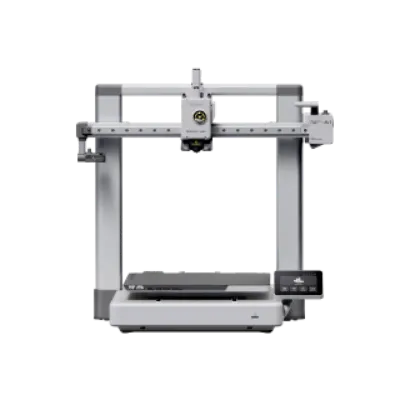
2. Bambu Lab A1 Mini — small space or tighter budget

The same user experience as its bigger sibling for €299, with a 180 mm bed. The trade-off is volume: helmets and large props won't fit. For figures, small functional parts and learning, probably the best ease-per-euro available.

3. Creality Ender 3 V3 KE — the open alternative

Heir to the best-selling 3D printer lineage ever, now with auto leveling and 500 mm/s. It loses to the A1 on ecosystem polish but wins on openness: firmware, mods and generic spare parts. If tinkering appeals to you more than "it just works", this is your pick.

4. Creality K1C — if you already know you'll want ABS

Enclosed from the factory, 600 mm/s and a nozzle ready for carbon-fiber filaments. It costs more than the open machines, but if your plans include engineering parts (ABS, ASA, nylon) you skip buying a second printer later.

K1C vs Centauri Carbon →

5. Elegoo Centauri Carbon — enclosed at an aggressive price

Elegoo's statement machine: an enclosed CoreXY at open-printer money (€349). The classic trade-off of buying from the challenger brand: a less mature ecosystem than Bambu/Creality.

Mention: miniatures? — Elegoo Mars 5

If your only goal is tabletop miniatures, a starter resin printer like the Mars 5 (€209) delivers detail no FDM can match — at the cost of gloves, IPA, curing and ventilation. More options in our resin picks.

How we choose

Specs come from our database, cross-checked against each manufacturer's official spec sheet (the exact source is cited on every printer page). The selection criteria — which machines give beginners the least trouble — are a synthesis of independent reviewers' conclusions (Tom's Hardware, All3DP, 3DPut and others, cited below) cross-checked with verified data. Except for the Bambu Lab A1 — the one I use daily — we don't test each model in person: everything else comes from those cited reviews. Amazon links are affiliate links: they earn us a commission at no cost to you and don't alter the order of recommendations (full policy).

FAQ

How much does a good beginner 3D printer cost in 2026?
Between €200 and €400 you get machines with full auto-calibration and excellent PLA/PETG quality. Below €200 you usually pay the savings back in calibration hours and frustration.
Do I need electronics or programming knowledge?
Not anymore. 2026 printers self-calibrate and ship with guided software. If you can install an app and follow a wizard, you can start printing.
Filament (FDM) or resin to start?
FDM, unless your only goal is highly detailed miniatures. Resin requires gloves, isopropyl alcohol, UV curing and more cleanup — better as a second printer.
Which filament should I use the first months?
PLA: cheap, easy, doesn't need a hot chamber and is perfect for learning. Once you get the hang of it, PETG for parts that need more strength.

Sources and further reading